
The DfE has dropped Herefordshire's approved 80-place special free school and given the council £3.8m instead. The council's own report puts a new one at circa £25m.
The Department for Education has dropped the 80-place special free school it had already approved for Herefordshire, because no academy trust was ever appointed to run it and it would not have opened until after 2030.
That is not in the council’s press release. It is in the report behind it. On 28 August, Herefordshire Council announced that it would invest “over £9 million” of DfE capital grant in more local school places for children with special educational needs and disabilities. The full decision record and the main report say considerably more than that.
What the DfE cancelled, and what it paid instead
The report is blunt about the free school. Paragraph 23 records that the DfE “previously approved a planned 80-place special free school for Herefordshire”, and has “since confirmed that the planned school will not continue because no trust had been appointed and the school would not open until beyond 2030”.
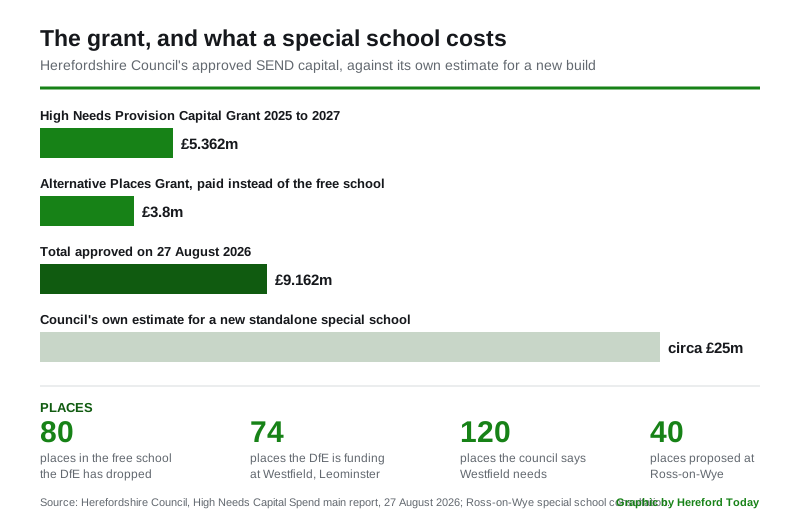
In its place the DfE has given the council a Special and Alternative Provision Free School Alternative Places Grant of £3.8m. The report sets out exactly how that number was reached:
- 80 places
- multiplied by £50,000 a place
- multiplied by a 0.95 regional adjustment
- profiled over three years
The council does not pretend this is a swap. Paragraph 26 states that £3.8m “is not sufficient to deliver a standalone 80-place special school”, and that capital costs for a new special school would be “likely in the region of circa £25m or more”. Paragraph 27 says the money “should therefore be regarded as a contribution to the wider high needs capital programme, rather than a like-for-like replacement for the withdrawn special free school”.
The headline number is £9.162m, not “over £9 million”
The decision approves spending of up to £9.162m, made up of two DfE grants:
- £5.362m High Needs Provision Capital Grant 2025 to 2027
- £3.8m Special and Alternative Provision Free School Alternative Places Grant
No council borrowing and no additional council capital contribution is sought. The money will pay for support bases in mainstream schools, expansion of existing specialist provision, and buying, adapting or refurbishing suitable buildings or land.
There is no fixed list of schemes. The report argues against one, on the grounds that individual costs and delivery routes remain subject to feasibility, site availability, procurement and DfE design work. Authority to award contracts and vary the programme is delegated to the Service Director for Education, Learning and Skills.
Westfield School in Leominster is funded for 74 places, and the county needs 120
Westfield School is a community special school in Leominster, about 12 miles north of Hereford. It is in the DfE’s School Rebuilding Programme.
The rebuild the DfE is funding is for 74 pupils. The report states that “Herefordshire’s identified need is for an expanded number of places, currently anticipated as up to 120 places”.
The gap between those two figures is the council’s problem to pay for. The report says the council’s contribution “is expected to represent the difference in build cost between the DfE-funded 74-place School Rebuilding Programme scheme and any agreed expanded scheme”, and that the figure cannot be confirmed until the DfE’s design work has gone further.
Two other things in the report are worth knowing:
- The expansion may need land assembly next to the existing site, or a different site altogether, if the preferred scheme will not fit. No decision on that is sought yet.
- The DfE’s indicative programme for the rebuild “runs to July 2030”.
Westfield’s own Get Information about Schools record lists a capacity of 74 places and 74 pupils on roll. The school is full.
The Ross-on-Wye proposal is 40 places, in a building the council already owns
Separately, and on the same day, the council opened a consultation on a new special school in Ross-on-Wye, about 14 miles south east of Hereford. The consultation document sets out the proposal:
- a special school for 40 places when fully open
- for children aged 4 to 11
- designated Moderate and Additional Learning Difficulties, which the council stresses “is not simply an MLD school”
- non-residential, with all pupils holding an Education, Health and Care Plan
- at the former Children’s Centre at the Ryefield Centre, Grammar School Close, Ross-on-Wye, HR9 7QD
- proposed to open in September 2027
The refurbishment cost is put at £1.2m, funded from the high needs capital allocation grant. The building is already in council ownership, and the document says a 125-year lease to the successful academy trust is anticipated if the winning proposal is for an academy. It also says “it is understood planning will not be required”, and that the facilities will not be available for community use because access is limited.
The council’s stated reasons for needing it are specific: existing special schools are already “supporting pupils above their commissioned numbers”, and the county lacks provision for children whose learning difficulties sit alongside communication, autism, speech and language or social, emotional and mental health needs.
Two dates that matter this week
Wednesday 3 September 2026 is the call-in deadline on the £9.162m decision. It was published on 27 August and comes into force on 4 September if it is not called in. The register recorded a call-in count of zero when we read it on 1 September.
12 noon on Friday 2 October 2026 is the deadline for responses on the Ross-on-Wye school. If the council proceeds, it will publish an invitation notice under section 7, inviting proposals for who should run the school, by 23 October 2026.
What it means for you
- If your child was waiting on the 80-place free school, it is not coming. The council is now working towards a 40-place primary-age school in Ross-on-Wye for September 2027 and a larger Westfield in Leominster, on a DfE timetable that runs to July 2030.
- You do not have to be a parent to respond to the consultation. The council is explicitly inviting local residents, community organisations, the town council and the ward councillor, partly because the Ross site sits in a residential street.
- Respond by noon on 2 October. Use the online survey, email educationaldevelopment@herefordshire.gov.uk, or write to Hilary Jones, Head of Additional Needs, Herefordshire Council, Plough Lane, Hereford, HR4 0LE.
- If you want to challenge the £9.162m decision, the window closes on 3 September. Call-in is a councillor process, so it runs through your ward member.
- Most pupils are expected to travel in by council-arranged taxi or minibus. The consultation says the successful operator will have to work with the home-to-school transport team on a travel plan.
For the rest of what the council decides locally, see our Hereford planning news page, and our guides to bin collection days, parking in Hereford and council tax bands.
Sources
- Herefordshire Council, High Needs Capital Spend, decision record 11283, decided 27 August 2026
- Herefordshire Council, High Needs Capital Spend, main report (PDF)
- Herefordshire Council, Council invests over £9 million in grant funding, 28 August 2026
- Herefordshire Council, Proposal to establish a new special school in Ross-on-Wye, published 24 August 2026
- Department for Education, Get Information about Schools: Westfield School
Have your say