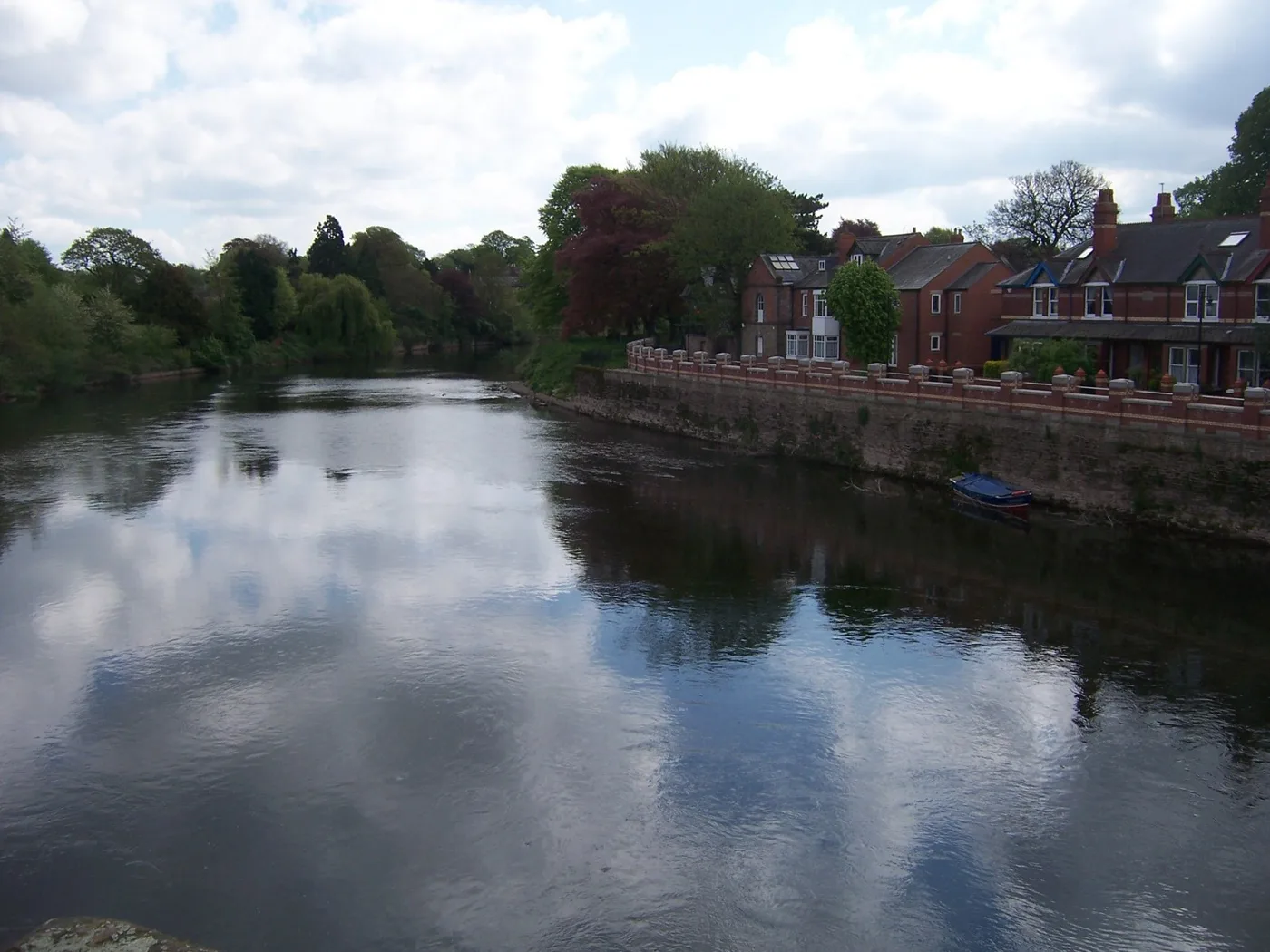

The Wye at Belmont averaged 3.30 cubic metres a second over the first half of August, below the 3.34 of August 1976, the lowest August in a 90-year record.
The River Wye at Hereford is running lower this month than it did in the drought summer of 1976.
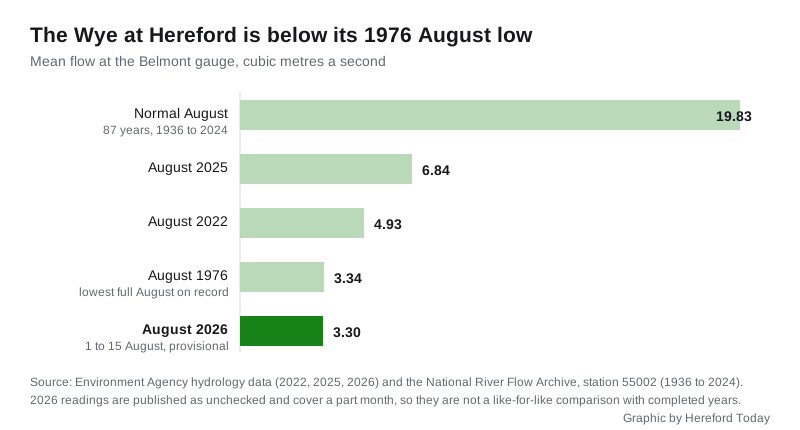
The Environment Agency’s gauge at Belmont, on the south-western edge of the city, recorded a daily mean flow averaging 3.30 cubic metres a second across the first 15 days of August. The lowest full August in the gauge’s record is August 1976, at 3.34. The record starts in October 1935.
The lowest single day so far was 3.14 cubic metres a second, on 14 August. (Environment Agency hydrology data, Wye at Belmont)
How far below normal that is
The long-run average for August at Belmont is 19.83 cubic metres a second, taken from 87 Augusts between 1936 and 2024. This month’s flow is about 17 per cent of that.
A second benchmark is more telling. The National River Flow Archive puts the gauge’s Q95 at 6.17 cubic metres a second. Q95 is the flow the river exceeds 95 per cent of the time, so it is close to the definition of a dry river. The Wye at Hereford is currently running at a little over half of it.
The gauge’s average flow across all months and all years is 47.55 cubic metres a second, from a catchment of 1,896 square kilometres. (National River Flow Archive, station 55002)
July was already the driest on record here
August is not an isolated month. July 2026 averaged 4.34 cubic metres a second at Belmont across the full month. The previous lowest July in the record was July 1976, at 4.38, from 88 Julys.
That comparison is a full month against full months, so it needs no allowances. On the gauge’s own record, July 2026 was the driest July the Wye at Hereford has seen.
The five lowest full Augusts in the archive are:
- August 1976: 3.34 cubic metres a second
- August 1984: 4.93
- August 1947: 5.31
- August 1949: 5.35
- August 1995: 5.43
August 2022, which the archive’s monthly series does not cover at this gauge, averaged 4.93 on the Environment Agency’s own daily readings. August 2025 averaged 6.84 and August 2018 averaged 8.00.
How we compared the years, and what to treat with caution
Two things are worth stating plainly, because they decide how much weight the “lower than 1976” line can carry.
The 2026 readings are provisional. Every daily figure from this month is published by the Environment Agency marked “Unchecked”, meaning it has not yet been through quality control and can be revised.
August is not finished. Fifteen days of 2026 are being set against complete months from earlier years. Flows at Belmont have fallen steadily every week since early July, so a full August 2026 could end lower still, but that is not yet a fact.
Against that, the two data sources agree closely where they overlap. For 2018, 2021, 2023 and 2024 the monthly mean computed from the Environment Agency’s daily readings matches the National River Flow Archive’s published monthly figure to three significant figures. The comparison is being made on a consistent basis.
One local caveat belongs in any Wye flow story. The archive records that this gauge sees “moderate flow modification, high levels of agricultural abstraction” upstream, and that its naturalised figures account for the Elan Valley reservoirs. The Wye at Hereford is not an untouched river, and it was not one in 1976 either.
The Environment Agency has named the Wye
The county sits inside the Environment Agency’s West Midlands area, which was declared in drought on 29 July. (Drought declared in half of England)
When the National Drought Group met on 10 August, it reported that 71.3 per cent of England was in drought and that only 14 per cent of monitored river flows were normal for the time of year. It named the rivers running exceptionally low, and the Wye is on that list, alongside the Avon, the Ely Ouse and the Exe. (More areas in England declared in drought after record dry July)
The consequence that matters most locally is already in writing. The agency’s weekly briefing for 31 July to 6 August said:
Formal restrictions may be required in the Wye catchment, West Midlands, later in August if the dry conditions continue.
(Dry weather and drought in England: 31 July to 6 August 2026)
“Formal restrictions” means a notice under section 57 of the Water Resources Act, which cuts what licensed abstractors may take. What that looks like in practice can be seen in East Anglia, where restrictions imposed from 10 August until 31 October cut 288 spray irrigation licences by 50 per cent, and 14 abstractors in the Wensum catchment were required to stop altogether.
The following week’s briefing, covering 7 to 13 August, moved the West Midlands into the group of areas where voluntary restrictions may be needed if the dry weather continues. It also recorded 1,544 abstraction licence restrictions in force nationally, and put the West Midlands among the areas with the highest number of confirmed abstraction and low flow incidents. (Dry weather and drought in England: 7 to 13 August 2026)
Low water is already costing fish. The Environment Agency reported 38 fish rescues by the end of July, including on the Teme, the Onny and the Redlake, moving brown trout, juvenile salmon, bullhead, grayling and lamprey.
What the weather is expected to do
England received 10 per cent of its long-term average rainfall in July, following the driest July in 190 years, and 5 per cent of the average in the first days of August.
The Met Office’s Sarah Davies told the National Drought Group that forecasts for the rest of August and into September suggested “a good deal of dry weather”, with “no strong signal for a sustained period of widespread rainfall” and below-average rainfall more likely than above.
What it means for you
There is no hosepipe ban in Herefordshire. Welsh Water’s temporary use ban has been in force since 10am on Sunday 19 July, but it covers affected parts of west Wales, not this county. (Dŵr Cymru Welsh Water) The Environment Agency’s list of active temporary use bans in England names eight companies, and none of them supplies Herefordshire. Severn Trent remains at drought level 1 in its North Staffordshire water resource zone only.
If you see fish in distress, report it. Fish gasping at the surface, stranded in isolated pools, or in numbers showing signs of distress should go to the Environment Agency’s 24-hour incident hotline on 0800 80 70 60. The Angling Trust’s head of fisheries, Mark Owen, says early reports give fisheries teams the best chance of acting in time.
If you hold an abstraction licence in the Wye catchment, the agency has said in writing that formal restrictions may follow this month. It says it is working with abstractors on any implementation, so the practical step is to make sure it has current contact details for you and to plan for a possible cut rather than a notice arriving unexpectedly.
If you swim, paddle or canoe on the Wye, treat the low flows as a change in the river rather than an improvement. Warmer water holds less dissolved oxygen, which is what puts fish under stress, and shallower water exposes gravel and obstructions that are normally well covered. Our things to do in Hereford page covers the riverside walks and the places the Wye runs through.
Saving water still helps here even without a ban. The water that is not used in Herefordshire homes is water that stays available for farms, wildlife and the river itself.
Sources
- Environment Agency hydrology API, Wye at Belmont daily mean flow
- National River Flow Archive, station 55002 Wye at Belmont
- Dry weather and drought in England: 7 to 13 August 2026
- Dry weather and drought in England: 31 July to 6 August 2026
- More areas in England declared in drought after record dry July, 10 August 2026
- Drought declared in half of England, 29 July 2026
- Dŵr Cymru Welsh Water, dry weather and restrictions
Have your say