

Herefordshire is forecasting an £11.6m overspend on its £234.1m budget three months in, and the reserve built to absorb exactly this is down to £1m.
Herefordshire Council is forecasting an £11.6m overspend for this financial year, on a net revenue budget of £234.1m, after only three months.
The figure is in the Q1 2026/27 Budget Report going to Cabinet on 24 September, written by the council’s Director of Finance in their statutory role as Section 151 Officer. The overspend is 5.0% of the net budget. Management action identified so far would bring it down to £10.7m.
The report does not soften it. The council’s reserves, it says, “are not sufficient to mitigate the forecast overspend at Quarter 1 without significant impact on the council’s overall financial resilience and therefore corrective action must be taken immediately”.
Where the £11.6m comes from
The overspend splits into two halves, and they are different problems.
- £3.6m is in-year cost pressure: services costing more than budgeted
- £8.0m is savings the council promised to make this year and now rates as “at risk”
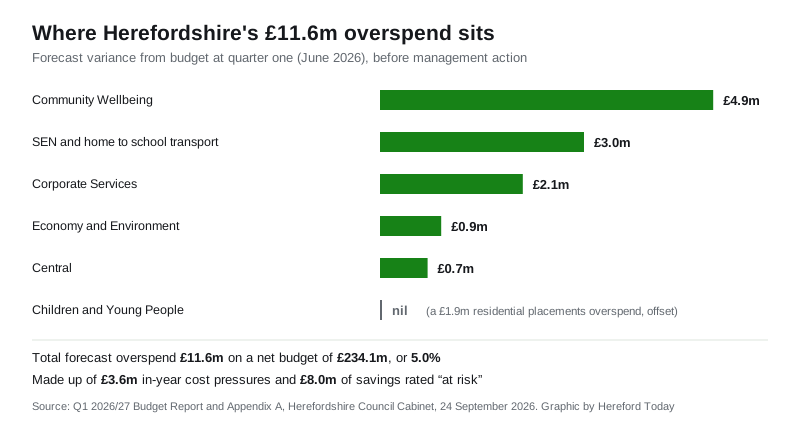
By directorate, before management action:
| Directorate | Budget | Forecast | Variance |
|---|---|---|---|
| Community Wellbeing | £89.2m | £94.1m | £4.9m |
| SEN and home to school transport | £14.1m | £17.1m | £3.0m |
| Corporate Services | £22.5m | £24.6m | £2.1m |
| Economy and Environment | £24.2m | £25.1m | £0.9m |
| Central | £25.5m | £26.2m | £0.7m |
| Children and Young People | £58.6m | £58.6m | nil |
| Total | £234.1m | £245.7m | £11.6m |
The biggest single pressure is adult social care and housing, £3.87m over its £85.0m budget. The report blames continuing demand and “a corresponding reliance on agency staff to enable the council to meet its responsibilities under the Care Act”. That is despite efforts to manage demand at the front door and more use of technology enabled care.
On homelessness, the report gives a blunt measure of the direction of travel: in quarter one “the number of households approaching the service exceeded the number of households rehoused into permanent accommodation”. We reported in August on the council’s 28 emergency flats at the John Venn building.
The zero that is not a zero
Children and Young People appears to be exactly on budget. It is not.
Inside that nil total sit two overspends:
- £1.9m on residential placements
- £1.075m in corporate parenting
They are cancelled out by:
- a £1.11m underspend in safeguarding and family support
- smaller underspends on unaccompanied asylum-seeking children, the families first prevention grant, supported accommodation and independent fostering agencies
- £0.6m of unbudgeted earmarked reserves drawn down to fund eligible spend
Across the council, £1.6m of unbudgeted reserves has been applied in this way in three months.
The savings that are slipping
Council approved £20.0m of savings for 2026/27. At the end of June:
- £7.5m (38%) delivered
- £1.2m on target, £4.8m in progress
- £6.5m (33%) assessed as at risk
A further £2.7m of savings were carried forward from previous years because they were never delivered. Of those, £0.3m (11%) has been delivered and £1.5m (56%) is at risk, including the entire £1.4m transformation savings target, none of which has been delivered or is even rated as in progress.
Those two at-risk figures, £6.5m and £1.5m, are what make up the £8.0m in the headline.
The cushion is nearly gone
This is the part that matters most for next year’s council tax and service decisions.
A Budget Resilience Reserve of £11.0m was set up in 2024/25 precisely to absorb social care demand shocks. The report tracks what has happened to it:
- £6.8m used across 2024/25 and 2025/26 on Community Wellbeing pressures, leaving £5.2m
- £4.2m transferred into a Contract Inflation Fund for 2026/27
- £1.0m left
The report states plainly that this “is not sufficient to manage the overspend forecast at Quarter 1”.
Other reserves exist but are held against other risks: a Financial Resilience Reserve of £2.5m, a Business Rates Risk Reserve of £10.0m, and a General Fund balance of £10.1m which the report describes as “a strategic reserve to be used in the event of a major incident or emergency”. Anything not recovered by 31 March 2027 has to come out of earmarked reserves.
Expenditure controls first brought in during 2023/24 remain in place, with directorate panels reviewing spending on goods and services and changes to staffing, and challenging forecasts to “reduce, defer and stop spend”.
Two numbers that sit outside all of this
The schools deficit. The council’s cumulative Dedicated Schools Grant deficit was £36.3m on 1 April 2026. A deficit budget of £25.9m is approved for this year, so if spending stays within it the cumulative deficit reaches £62.2m by 31 March 2027. It is currently ring-fenced off the council’s balance sheet by a statutory override that expires on 31 March 2028. The council submitted its Local SEND Reform Plan to the Department for Education on 19 June, which if approved would bring a High Needs Stability Grant covering about £32.7m, 90% of the historic deficit, expected in autumn 2026. The remaining 10%, £3.6m, becomes the council’s own liability when the override ends. We reported in August on the 80-place special free school that will not now open.
The capital programme. The approved £146.9m capital budget for 2026/27 has been revised to £169.3m, but forecast spend is £112.4m. Of the £56.9m difference, only £1.0m is a genuine underspend. The other £55.9m is project budgets rolling into 2027/28.
What it means for you
No decision is being taken to cut anything on 24 September. Cabinet is asked to review the forecast, note the management action and agree it continues. Cuts, if they come, arrive through the budget process for 2027/28.
One visible service change is already banked as a saving. Economy and Environment reports a £0.8m underspend from “deferral of waste collection of soft plastics”. Separately, weekly food waste collection, legally due in March 2026, was pushed back to autumn 2027. Current arrangements are on our Hereford bin collection days page.
The next check is in November. The quarter two report, with updated SEND demand data for the new academic year, goes to Cabinet then.
You can attend or watch. Cabinet meets at 2.30pm on Thursday 24 September in Conference Room 1 at Plough Lane, and the meeting is streamed on the council’s YouTube channel. The deadline for public questions was 5pm on 18 September.
Sources
- Q1 2026/27 Budget Report, Cabinet, 24 September 2026
- Appendix A: Revenue outturn
- Cabinet agenda, 24 September 2026
Related: Herefordshire council tax bands and Hereford planning news.
Have your say