
Cabinet's 24 September report says design changes have pushed costs up and much of £3.5m in planned savings is unachievable. Re-tendering is now a formal option.
Herefordshire Council could scrap the contractor arrangement it has spent a year and a half building on the Hereford Western Bypass and start the search for a builder again.
That option is written into the recommendations of the Western Bypass Phase One Update Report going to Cabinet on Thursday 24 September. The report, by Corporate Director for Economy and Environment John Hobbs, asks Cabinet to hand him the power to decide which way the scheme goes next.
The reason is money. Design work carried out this year has pushed the estimated cost of the works up. At the same time, the savings the council was relying on to keep the scheme inside its £45.3m budget have turned out to be smaller than planned.
The savings the sums depended on
To understand why that matters, you have to read this report alongside the Full Business Case published on 4 August.
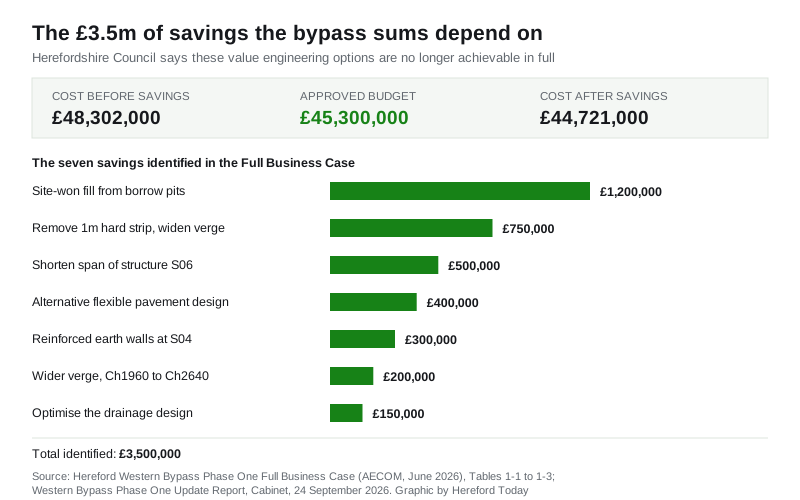
The business case gave two different totals for Phase One:
- £48,302,000 before any value engineering savings
- £44,721,000 after £3,500,000 of value engineering savings
Only the second of those fits inside the £45.3m the council has approved. The first is about £3m above it. Value engineering is the process of redesigning parts of a scheme more cheaply, and AECOM’s business case listed seven specific savings the contractor had identified:
| Change | Saving |
|---|---|
| Replace imported fill with site-won material from borrow pits | £1,200,000 |
| Remove 1m hard strip, replace with wider verge through cuttings | £750,000 |
| Shorten the span of structure S06 | £500,000 |
| Alternative flexible pavement design for the mainline | £400,000 |
| Reinforced earth walls instead of long concrete wingwalls at S04 | £300,000 |
| Widen the verge through the cutting at Ch1960 to Ch2640 | £200,000 |
| Optimise the drainage design | £150,000 |
The new report says that work to validate those options “has also identified that planned savings to reduce total scheme cost are not achievable as they would require additional planning consents or impact on the extant, principal planning consent”.
Going back for more planning permission is ruled out in the next paragraph, because the delay “would increase scheme costs and erode the savings being sought”. The result, in the report’s words, is “a reduction in the amount of savings VE options can have on the construction budget”.
The report does not say which of the seven savings survive and which do not, and it does not publish a new total. That number is still being worked out.
Three separate cost pressures
The report names three things pushing the price up.
New national standards. The contractor has been working with National Highways and Network Rail since it was appointed. The report says “it has become apparent that revisions to the scheme were required to accommodate changes to road and bridge standards implemented by National Highways through the revised Design Manual for Roads and Bridges”.
Construction inflation. The report attributes this to supply chain disruption from conflict in the Middle East, and cites Department for Business and Trade preliminary figures showing construction materials prices for “All Work” rose by 6.0% in the 12 months to June 2026.
The shrinking value engineering savings set out above.
Councillor Philip Price, Cabinet member for transport and infrastructure, put it this way in the council’s statement on 18 September:
Major infrastructure projects are complex, and the pre-construction stage is doing what it is supposed to do: testing the design, exposing risks, understanding costs and making sure we have a deliverable plan before any decision is made to move into the main construction contract.
What Cabinet is actually being asked to authorise
This is the part that is not in the council’s news release.
Recommendation (c) asks Cabinet to let the Corporate Director “conclude corrective action in the PCSA process with the contractor” to bring the works and costs inside the budget. The PCSA is the Pre-Construction Services Agreement, the early-stage contract that lets a builder design the road before committing to build it.
Recommendation (d) then says that once he has finished that review, he decides between two routes set out in paragraphs 24 and 25:
- If he judges the corrective action will produce a construction contract within budget, he reports back to Cabinet to seek approval of the full business case and its assessment against the criteria Cabinet adopted in April.
- If he judges it will not, he must “conduct a procurement process with the intention to award a new Construction Contract to build the Western Bypass Phase 1”, or go back to Cabinet with alternative proposals if even that cannot be achieved.
In plain terms: the council’s own paper now contemplates going back out to the market for a different builder. The only alternative option the report offers Cabinet is to let the current contractor simply submit its bid, which officers do not recommend because the council “would receive an incomplete bid”.
The contractor working under the PCSA is named in the business case as Graham, with AtkinsRealis as its design partner.
One landowner will not sell
The report also gives the clearest published account yet of the land position. Phase One needs seven parcels of land:
- one is already owned by the council
- heads of terms are agreed with four landowners
- heads of terms are being finalised with one
- the remaining landowner “does not wish to negotiate with the council any further”
Because of that, and to extinguish unknown third-party rights, the Compulsory Purchase Order and Side Roads Order agreed by Cabinet in December 2025 must now go ahead. They will also be revised, because design work has identified further land and rights that need to be included.
The timescale is the striking part. The report says any final decision by the Secretary of State “is still expected to take 12-18 months”, measured from the point the Orders are ready to be issued, not from today. The council has been advised it can sign a construction contract before all the land is bought, provided the outstanding land is covered by the Orders.
What it means for you
Construction is not starting in December for all of the route. The council’s stated ambition has been to begin construction by December 2026, and Councillor Price’s statement now describes that as something the council “has previously been clear about”. The report says final design works and costings will be completed “during the Autumn”. It then adds a hard seasonal limit: where entry works for vegetation clearing and fencing are not completed by October, construction in those areas is “likely” to be unable to start until May 2027.
Preparatory work has already begun. The council says site preparation, fencing, ground investigations, trial holes and drainage and pavement surveys are under way.
Money is already committed. The report records £4.0m spent to September 2026, with a further £1.6m committed. The £45.3m budget is entirely the council’s own capital and borrowing, approved in three votes: £10.3m by Council in December 2023, £30.0m in February 2025 and £5.0m in February 2026. There is no government grant.
Nothing is decided on 24 September. Cabinet is being asked to note progress and delegate the next judgement. Whichever route the Corporate Director picks, the report promises the full business case will come back to Cabinet before any construction contract is awarded.
You can watch it. The meeting is at 2.30pm on Thursday 24 September in Conference Room 1 at the council’s Plough Lane offices, and is streamed on the council’s YouTube channel.
Two things still unresolved
Connected Communities Scrutiny Committee made nine recommendations on the business case on 20 July, which Cabinet accepted on 30 July. One was that Cabinet consider increasing the contingency budget. The report says that is “being picked up by the Council’s external Quantity Surveyors”, and gives no figure.
And the council’s Back the Bypass campaign page still told readers on 19 September that “early indications assess the likely benefit-cost ratio (BCR) at 1.8 - 2.5, meaning a ‘medium to high’ value for money return”. The finished business case, published six weeks ago, gives an initial BCR of 1.5 and an adjusted BCR of 1.6. We reported that gap on 25 August. It has not been corrected.
One inconsistency in the report itself is worth recording: paragraph 6 and recommendation (a) both date the contractor’s appointment to 30 April 2026, while paragraph 22 says the PCSA “was awarded in March 2026”.
Sources
- Western Bypass Phase One Update Report, Cabinet, 24 September 2026
- Cabinet agenda, 24 September 2026
- Hereford Western Bypass Phase One Full Business Case, AECOM, June 2026
- Herefordshire Council news release, 18 September 2026
Related: Hereford bypass: £44.7m cost, Cabinet decides 10 September and Hereford Bypass: contract vote off, paths shut 14 Sept. For live closures see Hereford roadworks and travel, and for applications near you, Hereford planning news.
Update, 28 September 2026: Cabinet approved all four recommendations on 24 September. The Corporate Director for Economy and Environment now has the power to conclude corrective action with the contractor and then choose between the routes in paragraphs 24 and 25, including a new procurement. The decision can be called in until 30 September and takes effect on 1 October if it is not.
Have your say